

Versatile Lightweight & Ultralight Backpacking Tarp Recommendations
A backpacking tarp is one of the most versatile and lightweight pieces of outdoor gear. Your tarp can become a super ultralight shelter, an emergency bivy, a wind wall, a shade patch, the tent’s front porch, a dry spot under which to take a lunch break, or a roof over the communal kitchen area while group camping. When pitched properly, a tarp is more wind-worthy than a freestanding 3-season tent!
This buyer’s guide is grounded in literal decades of experience using, pitching, configuring, and camping with tarps. We highly recommend adding a backpacking tarp into your quiver, and are confident you will find lots of ways to use it. We cover both flat tarps and catenary tarps, and address pyramid tents separately.
Jump ahead to read our pro tips and buyer considerations. And while you’re here, you may also be interested in our guides to backpacking tents, sleeping pads, quilts, sleeping bags, and trekking poles.
You make Adventure Alan & Co possible. When purchasing through links on our site, we may earn an affiliate commission at no additional cost to you. Here’s why you can trust us.
Backpacking Tarp Quick Picks
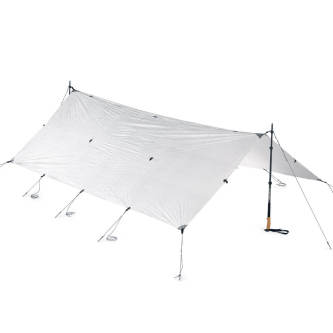
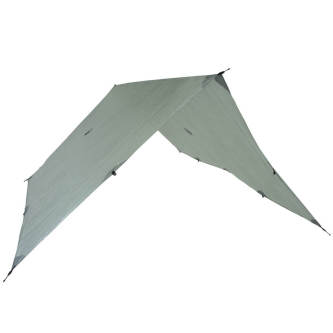
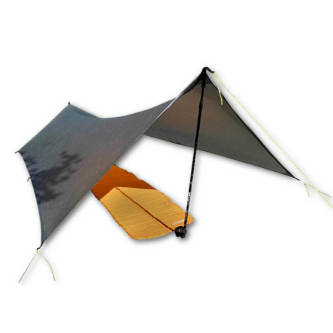
- Top Ultralight DCF Pick: Zpacks Flat Tarp
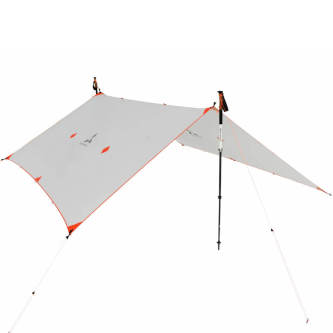
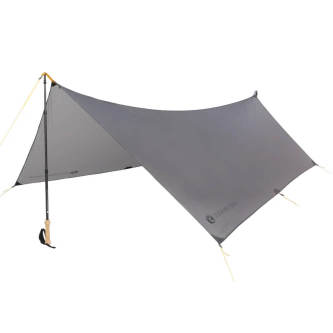
- Top Ultralight DCF Pick: Hyperlite Mountain Gear Flat Tarp
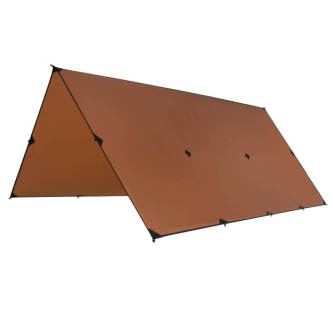
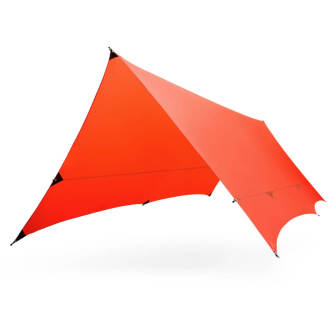
- Top Ultralight DCF Pick: Mountain Laurel Designs SuperTarp
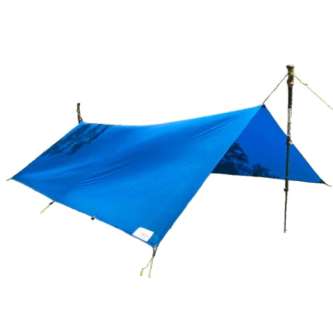
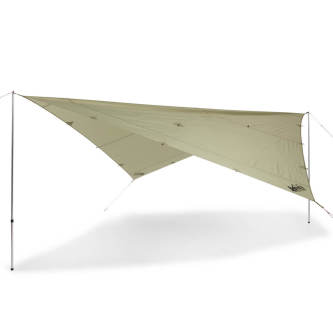
- Top Ultralight DCF Pick: Hammock Gear Flat Ground Tarp
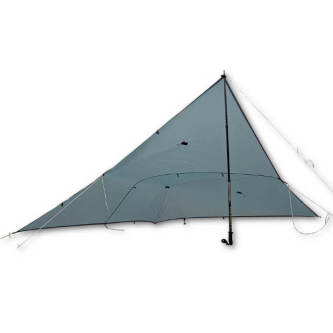
- Top Value Pick: SlingFin NFT
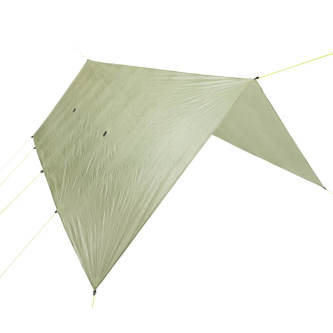
- Top Budget Pick: Hammock Gear The Traverse
- Top Sustainability Pick: ANDA Ultralight El Jefe
- Best Catenary: Mountain Laurel Designs Grace Tarp
- Best Value Catenary: Gossamer Gear Twinn Tarp
- Best Extra Large Group Shelter: Kammock Kuhli XL Group Tarp Shelter
- Best Value Large Group Shelter: REI Co-op Trailbreak Tarp
Best Shaped Tarp Shelters
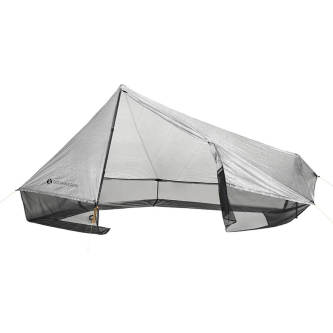
- 1P: Gossamer Gear The DCF Whisper
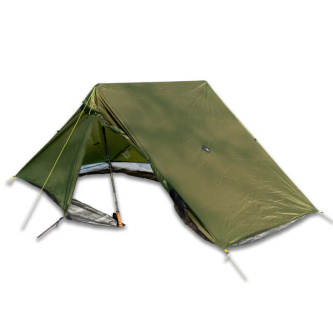
- 2P: Six Moon Designs Owhyee Backpacking Tarp
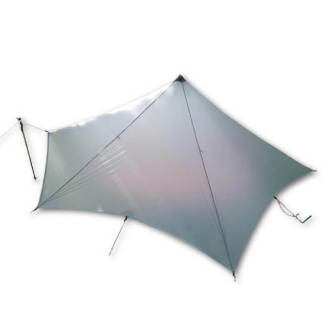
- 3P: Mountain Laurel Designs Trail Star
Backpacking Tarp Accessories
- Ground Cover: Gossame Gear Polycryo Ground Cloth
- Preferred Stakes: AnyGear 7075 Y-Stakes
- Bivy Sack: Katabatic Gear Piñon Bivy
Best Backpacking Tarp Comparison Table
Mobile users rotate device for full width table
| Price ($) | Weight + Cords (oz) | Shape | Fabric | Length (ft²) | Width (ft²) | Area (ft²) | ft²/oz | |
| Zpacks Flat Tarp | 399 | 8.4 | Flat | DCF .5 | 10.0 | 8.5 | 85.0 | 10.1 |
| MLD Grace Tarp 2 | 325 | 7.5 | Cat | DCF .75 | 9.3 | 7.8 | 71.7 | 9.6 |
| HG Flat Ground Tarp | 389 | 9.4 | Flat | DCF .5 | 10.0 | 8.5 | 85.0 | 9.0 |
| HMG Flat Tarp 2 | 369 | 9.0 | Flat | DCF .75 | 10.0 | 8.0 | 80.0 | 8.9 |
| GG Twinn Tarp | 130 | 9.7 | Cat | Nylon, 10d | 9.5 | 8.3 | 79.5 | 8.2 |
| MLD SuperTarp | 380 | 12.0 | Flat | DCF .75 | 10.0 | 8.5 | 85.0 | 7.1 |
| SlingFin NFT | 220 | 13.6 | Flat | Nylon, 10d | 10.0 | 9.6 | 95.8 | 7.0 |
| Kammock Kuhli XL | 250 | 33.4 | Flat | Nylon, 15d | 16.5 | 14.2 | 234.3 | 7.0 |
| HG The Traverse | 140 | 14.3 | Flat | Poly, 20d | 10.0 | 8.0 | 80 | 5.6 |
| ANDA El Jefe | 185 | 14.3 | Flat | Poly, 20d | 10.0 | 8.0 | 80 | 5.6 |
| REI Trailbreak Tarp | 80 | 33 | Flat | Poly, 75d | 12.0 | 12.0 | 144.0 | 4.4 |
| GG DCF Whisper | 499 | 9.8 | Hex | DFC .5 | 8.5 | N/A | N/A | N/A |
| SMD Owyhee | 310 | 24.6 | Hex | Nylon, 20d | 9.5 | 7.0 | 53.0 | 2.1 |
| MLD Trail Star | 470 | 12.0 | Pent | DCF .75 | 9.5 | 9.5 | 65.0 | 5.4 |
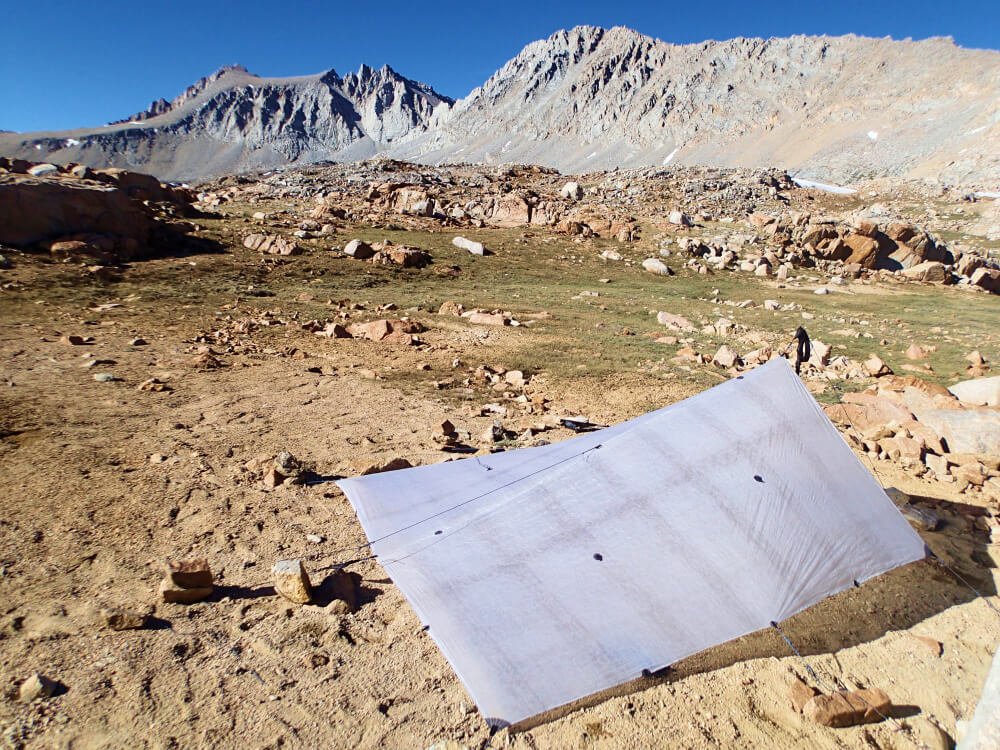
Top Picks: Ultralight Backpacking Tarp
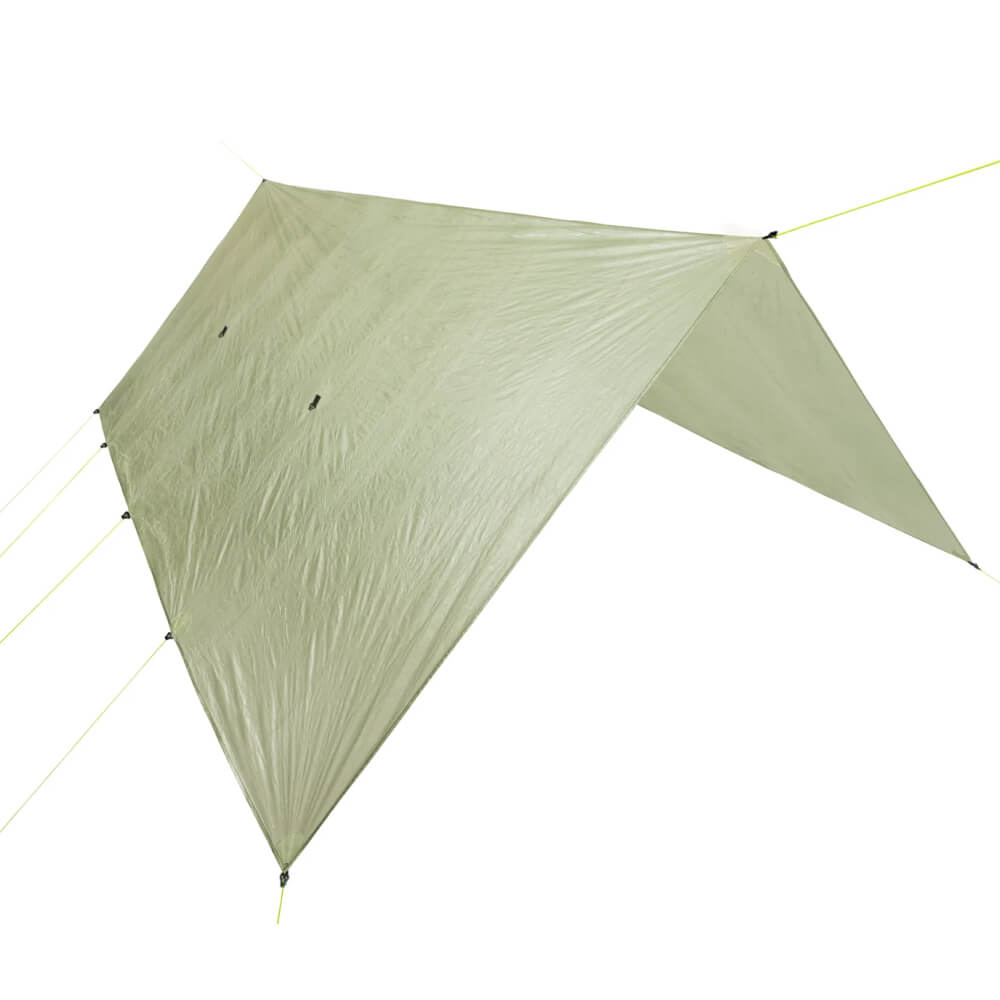
Zpacks Flat Tarp 10′ x 8.5′
The Zpacks Flat tarp offer full-size coverage in a super ultralight Dyneema package . By virtue of having slightly fewer tie-off points (though 14 is still plenty) and thinner .55 oz/sqyd fabric (still more than durable enough), it’s one of the very lightest weight 10′ x 8.5′ ultralight tarps on the market, even among other top tier DCF models. It’s also available as a 9×7.
- Price: $399
- Weight: 8.4 oz (with guy lines)
- Shape: Flat Rectangle
- Material: Dyneema .55 oz sq/yd
- Length x Width: 10′ x 8.5′
- Area: 85′ ft²
- Area/Weight: 10.1 ft²/oz
- Tie off points: 16
- Pros: Ultralight. Highest area-to-weight ratio. Best-in-class materials. Full size. Doesn’t sag if wet. Highly configurable.
- Cons: Most expensive. Use of thinner .5 DCF is less strong than .75 DCF. No tie-offs at 1/4 and 3/4 placement points on head/foot end edges.
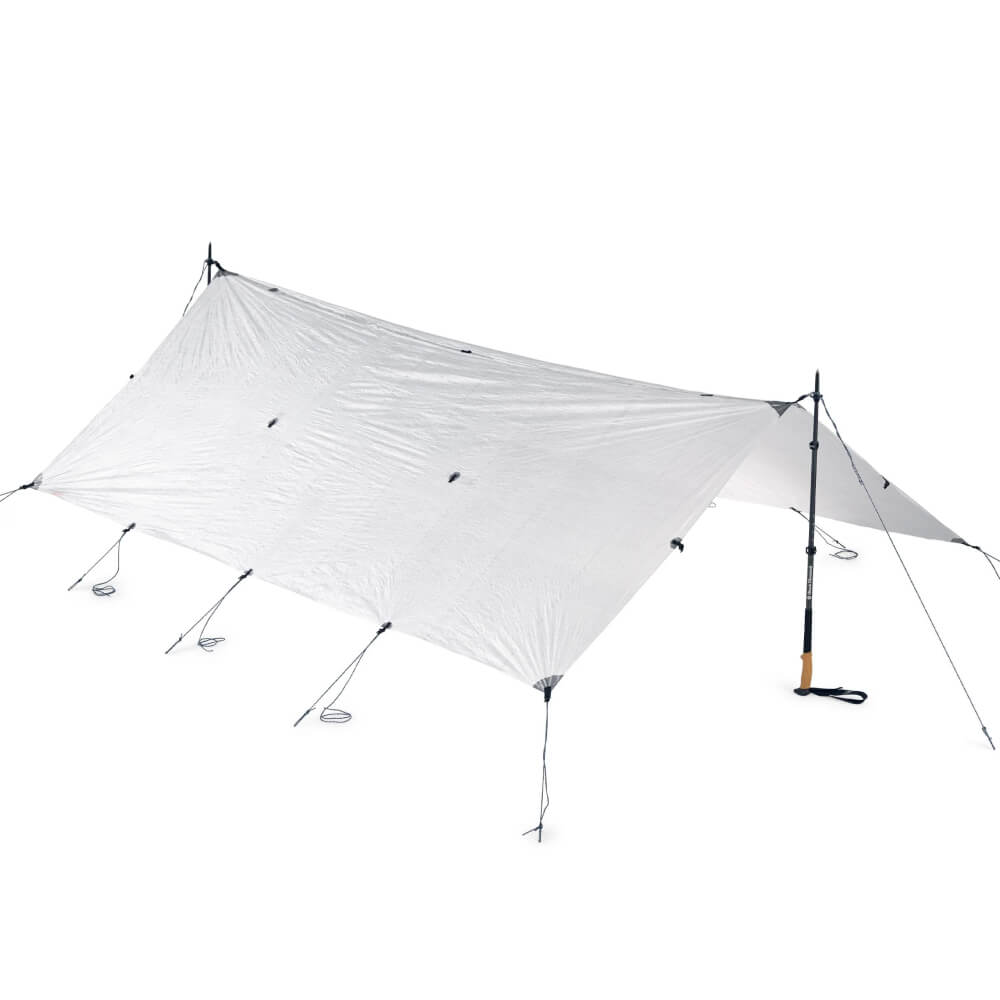
Hyperlite Mountain Gear Flat Tarp
HMG helped bring tarp camping into the mainstream with this iconic, white, Dyneema shelter. The .75 oz sq/yd DCF fabric is ultralight, durable, and long-lasting. The author is still using an HMG tarp from 2014 and you can see it pitched all over throughout this article. What’s more, HMG added an above average amount of tie off points, including a desirable center tie-off. Make sure to buy an extra hank of cordage. Perhaps our only complaint is that it’s 8′ wide instead of 8.5′. It’s also available in an 8.5 x 8.5 cut.
- Price: $369
- Weight: 9.0 oz
- Shape: Flat Rectangle
- Material: Dyneema .75 oz sq/yd
- Length x Width: 10′ x 8′
- Area: 80.0 ft²
- Area/Weight: 8.9 ft²/oz
- Tie Off Points: 21
- Pros: Ultralight. High area-to-weight ratio. Best-in-class materials. Full size. Doesn’t sag if wet. Highly configurable. Lots of tie offs.
- Cons: Expensive. Narrowest DCF model, 8.5′ wide is preferable to 8′.
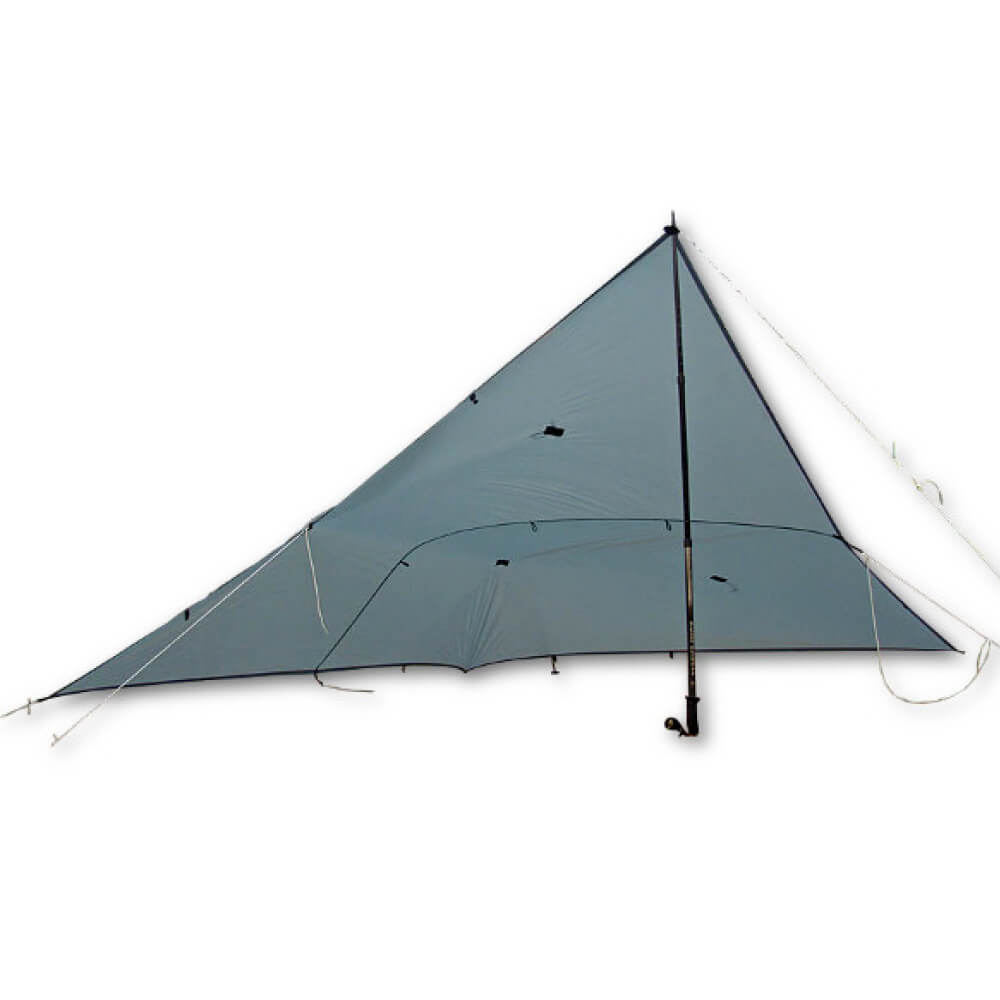
Mountain Laurel Designs SuperTarp (DCF)
So you want the most customizable pitch? Choose the MLD SuperTarp with 26 potential guylines, the most in our guide. Sewn with ultralight .75 oz sq/yd DCF, it’s waterproof, sag-proof, and capable of bearing incredible tension loads with well-reinforced tie-off points. One nice features is that the mid-panel tie offs have bungee cord loops, which “allows wind flex at those points without stressing the tarp.” It’s also available as in 10×10 SilPoly build and comes with 100′ of complimentary cordage.
- Price: $380
- Weight: 12 oz
- Shape: Flat Rectangle
- Material: Dyneema, .75 oz sq/yd
- Length x Width: 10′ x 8.5′
- Area: 85.0 ft²
- Area/Weight: 7.1 ft²/oz
- Tie Off Points: 26
- Pros: Ultralight. High area-to-weight ratio. Best-in-class materials. Full size. Doesn’t sag if wet. Highly configurable. Most guy-out points. Guy out points are well-reinforced. Also available for less as a 10×10′ SilPoly
- Cons: Expensive. 3-6 week lead time on orders.
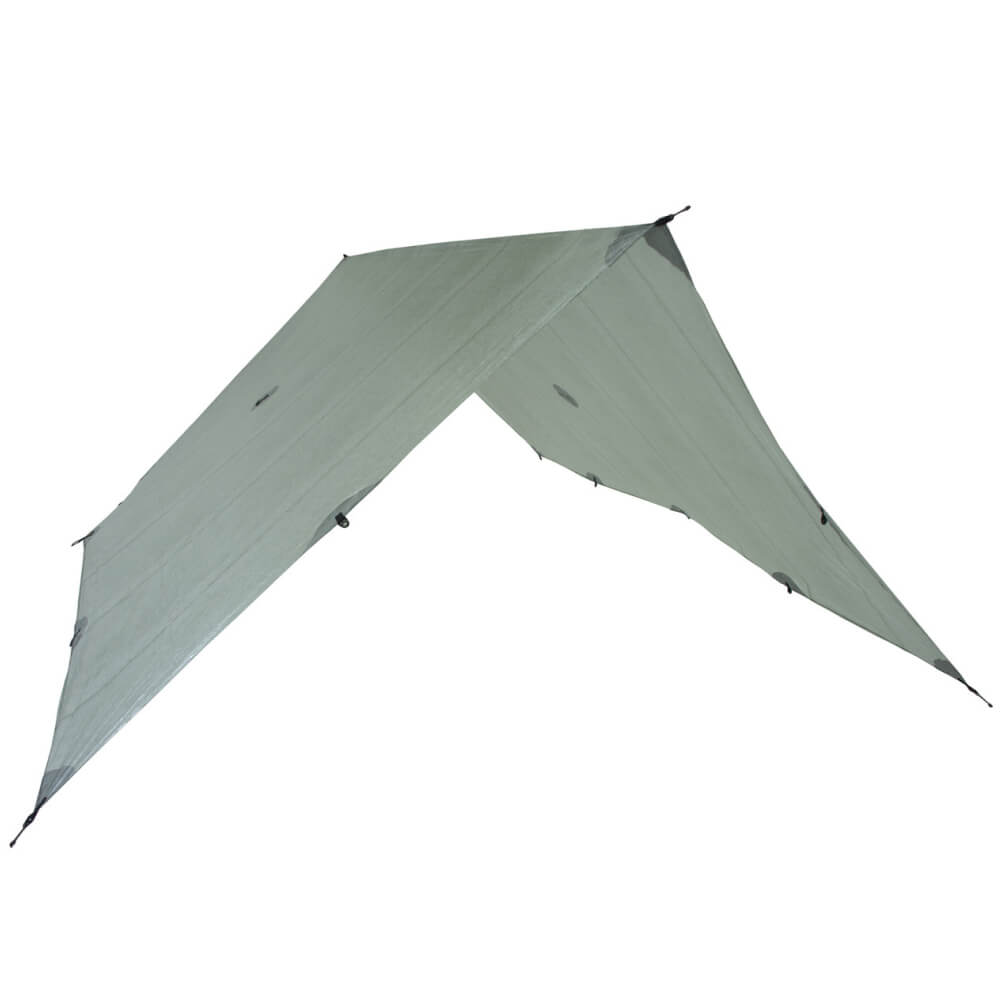
Hammock Gear Flat Ground Tarp (DCF)
Hammock Gear has been making best-in-class hammock tarps for ages, but they also offer a Dyneema Flat Ground Camping design. Just to be clear, the use of “ground” is to differentiate it from the hammock-specific models; do not use it as a ground sheet. This tarp is made with super ultralight .5 oz sq/yd Dyneema which doesn’t stretch or sag and is completely waterproof. It has 18 tie off points for wide ranging configrability, and is the only DCF model that can be ordered in a camouflage colorway. It’s also available an 8.5’x8.5′
- Price: $389
- Weight: 9.4 oz
- Shape: Flat Rectangle
- Material: Dyneema, .5 oz sq/yd
- Length x Width: 10′ x 8.5′
- Area: 85.0 ft²
- Area/Weight: 9.0 ft²/oz
- Tie Off Points: 18
- Pros: Ultralight. Full-size. High area-to-weight ratio. Best-in-class materials. Doesn’t sag if wet. Highly configurable. Option for camo colorway.
- Cons: Expensive. Cordage not included in price. Only one center panel tie-off. 1-2 week lead time on orders. Use of thinner .5 DCF is less strong than .75 DCF.
Top Picks: Lightweight Backpacking Tarp
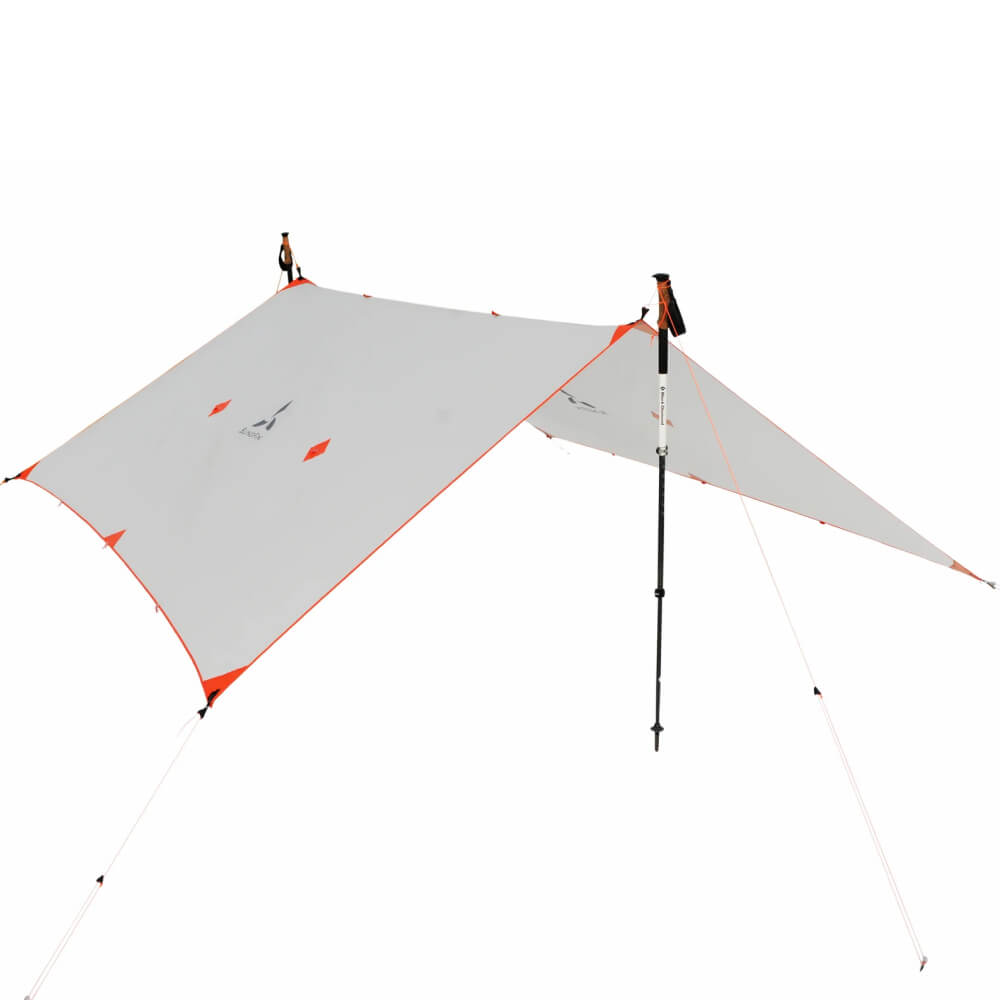
SlingFin NFT
We love SlingFin’s NFT (Nice Flat Tarp), and for just $220, it’s a killer value with some standout features and likely the best overall performance among non-Dyneema models. Firstly, the lightweight 10d sil/sil nylon fabric absorbs less water, sags less, and lasts longer than sil/pu alternatives. The generous 10′ x 9.5′ cut creates a nice touch of extra coverage, and we love the subtle catenary curves on the long edges, which makes for an extra taut pitch with less flapping.
This tarp has 18 total tie-off points, though only the 12 most important are reinforced. Did we mention that it comes with some nice and beefy 8″ DAC J-stakes? We tested the NFT as a communal kitchen shelter on a week-long five person backpacking trip in CO, and it performed marvelously. You can read more about how great this tarp is in our full-length SlingFin NFT Review.
- Price: $220
- Weight: 13.6 oz
- Shape: Flat with Catenary Edges
- Material: 10d sil/sil nylon
- Length x Width: 10′ x 9.6′
- Area: 95.8 ft²
- Area/Weight: 7.0 ft²/oz
- Tie Off Points: 12 reinforced, 18 total
- Pros: Full size+. Lightweight. Excellent value. Comes with big stakes. Sil/sil nylon is very strong and waterproof. Infinitely configurable. Catenary edges (but not ridgeline) decrease side flapping. Well-reinforced at all tie-out points. Perfect group shelter for 4-5.
- Cons: Light-not-ultralight. Fabric is slippery and can be difficult to pack away. Unusual tensioning hardware takes getting used to. Does not come seam-sealed.
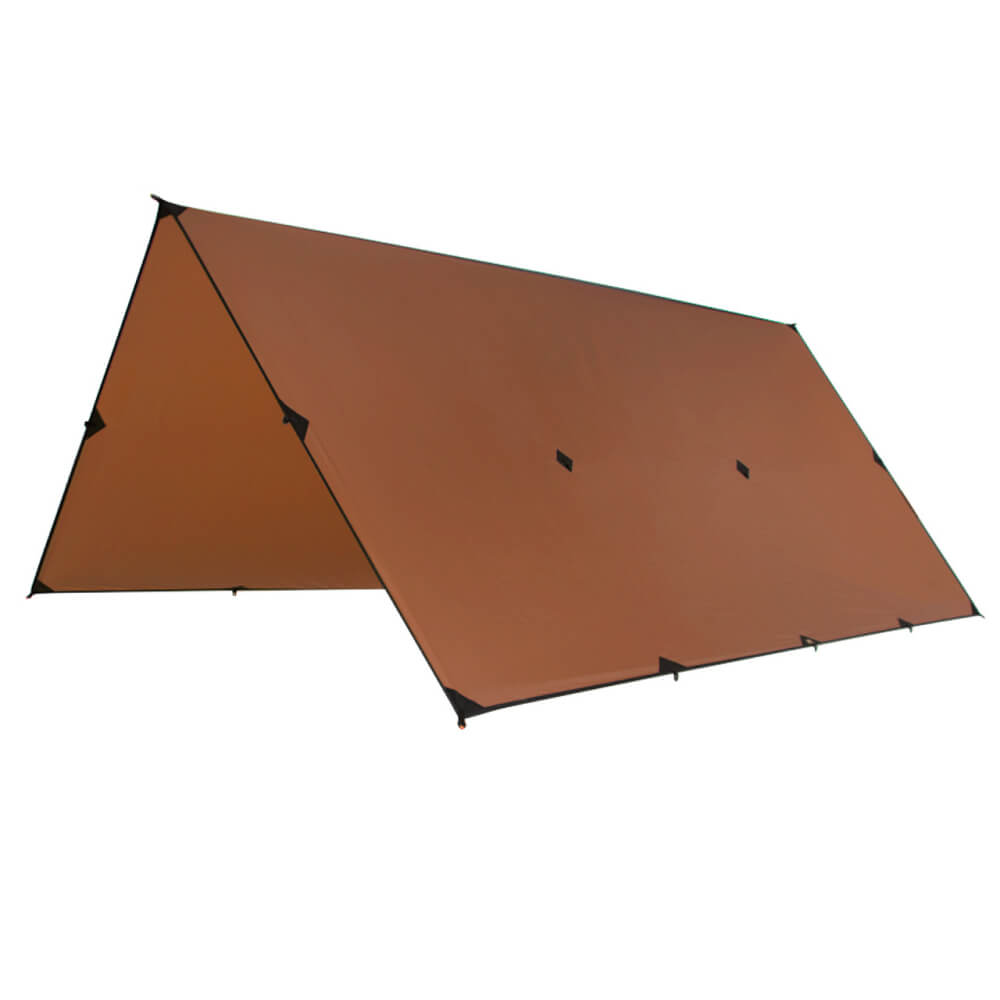
Hammock Gear Traverse Ground Tarp
The HG Traverse is a fully featured lightweight backpacking tarp for just $140 – such value! The use of “ground” in its name is to differentiate it from the hammock-specific models, not to imply it can be used as a ground-sheet; it cannot. The 20d sil poly has minimal stretch/sag, and is fully waterproof. It comes with a seam sealing kit, but you have to do it at home. We haven’t investigated tie-off-points-to-price ratio, but suspect this is the most customizable model under $200. It’s also available in a 9.5 x 9.5 shape.
- Price: $140
- Weight (with cords): 14.3 oz
- Shape: Flat
- Material: 20d silpoly
- Length x Width: 10′ x 8′
- Area: 80 ft²
- Area/Weight: 5.6 ft²/oz
- Tie Off Points: 20
- Pros: Lightweight. Exceptional value. Tons of tie outs. Complimentary seam sealant.
- Cons: 3-4 week lead time. Requires at home seam-sealing. Prefer 8.5′ wide to 8′.
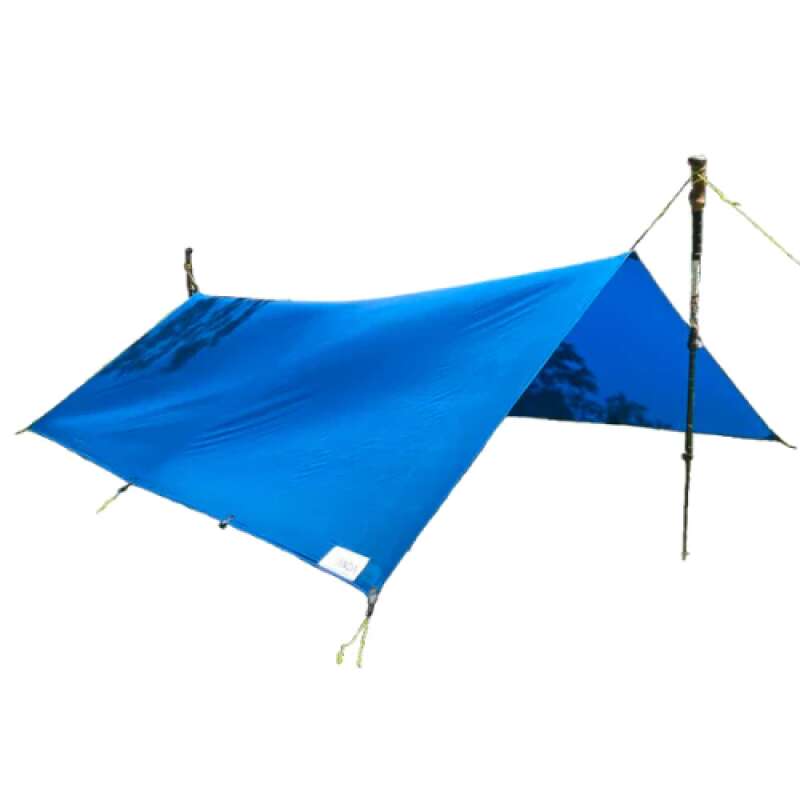
ANDA Ultralight el Jefe Tarp
We nod to the ANDA Ultralight el Jefe tarp for making the best use of 100% recycled fabric. Most eco-friendly tarps are not technical ultralight designs, instead forcing you to choose between performance and sustainability. But with ANDA tarps, you can have your cake and eat it too. The 100% recycled 20d sil-poly fabric reduces sag and minimizes stretch (though it still stretches on the bias). It has plenty of tie outs and quality guy lines and best-in-class LineLoc adjusters for all possible pitches, including interior loops for lofting the head end of a bivy sack. Plus it’s a killer value. Nice tarp!
- Price: $185
- Weight (with cords): 14.3 oz
- Shape: Flat
- Material: 100% recycled 20d silpoly
- Length x Width: 10′ x 8′
- Area: 80 ft²
- Area/Weight: 5.6 ft²/oz
- Tie Off Points: 12
- Pros: 100% recycled fabric. Lightweight. Great value. Good LineLoc adjusters. Well-made, durable sewn. Loops for interior bivy attachment. Sil-poly minimizes sag. Infinitely configurable.
- Cons: Requires at home seam-sealing. Prefer 8.5′ wide to 8′.
Top Picks: Catenary Cut Tarp
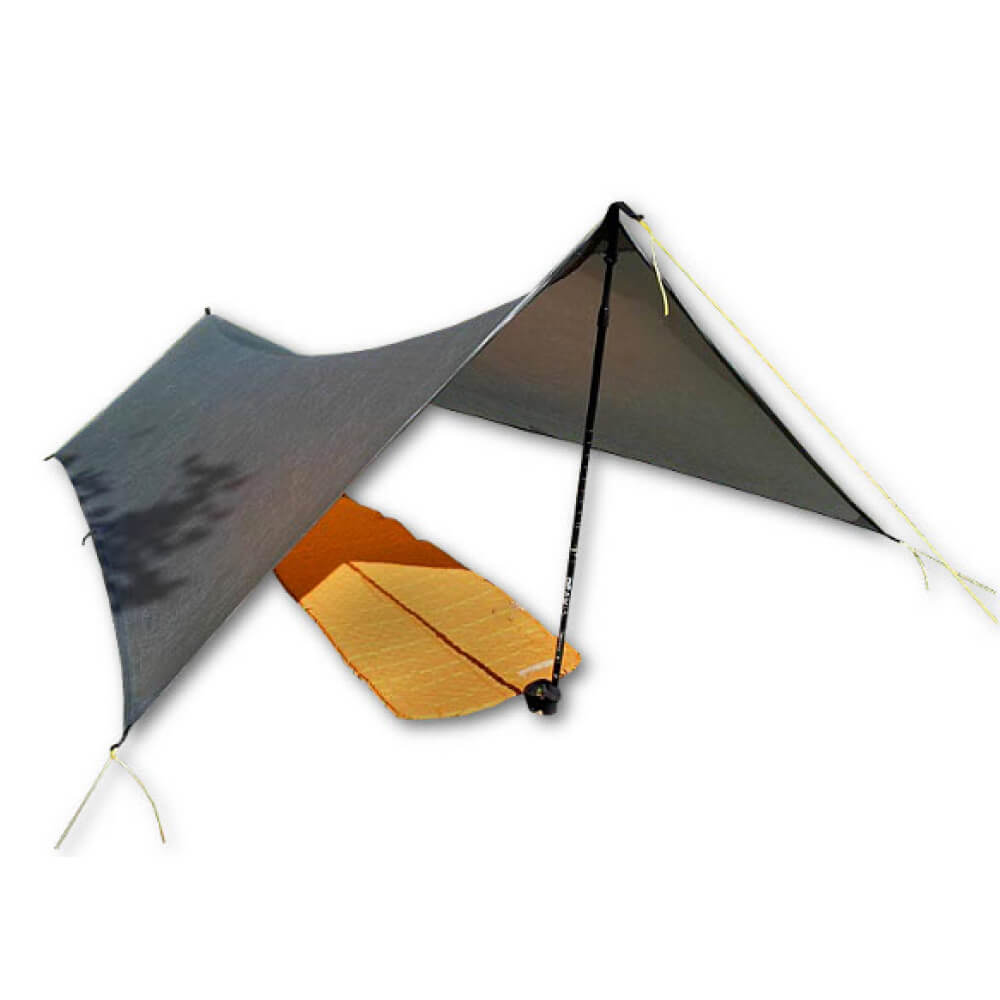
Mountain Laurel Designs Grace Tarp (DCF)
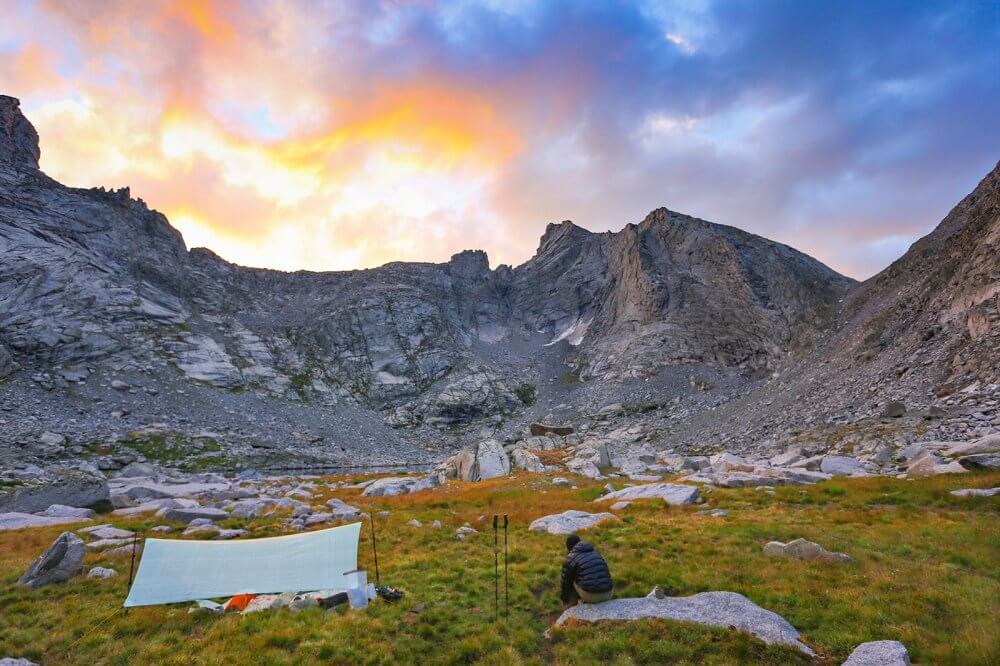
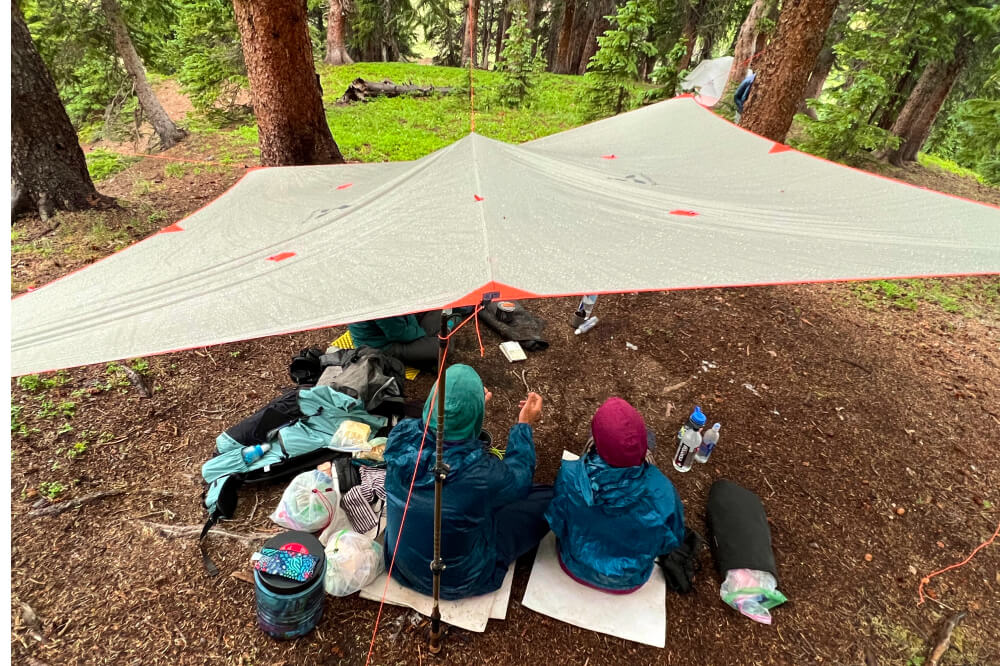
The MLD Grace in DCF is the clear best-in-class option among catenary tarps, and served Adventure Alan well on the Wind River High Route. The curved ridgeline plus trapezoidal shape makes for an easy setup and drum-tight A-frame pitch in an ultralight, 7.5 oz package. The clearly delineated widened and heightened head-end makes entry/exit easier, and gives you the ability to comfortably sit up without hitting your head. This tarp is also available in a more economical SilPoly fabric, as well as a smaller, 1P version. We’re always impressed by the sheer quality of MLD’s shelters, and the Grace Tarp is no exception. Highly recommended (and featured in the lead photo)!
- Price: $325
- Weight: 7.5 oz
- Shape: Catenary, Tapered
- Material: Dyneema .75 oz/sqyd
- Length x Width: 9.3′ x 7.8
- Area: 71.7 ft²
- Area/Weight: 9.6 ft²/oz
- Tie Off Points: 8
- Pros: Alan’s choice. Ultralight. Spacious. High area-to-weight ratio. Does not sag when wet. Perfectly tensioned A-frame pitch. Also available in a less expensive SilPoly fabric. Mini clip on ridgeline. User-friendly setup only needs 8 tie outs.
- Cons: A-frame only. 3-6 week lead time.
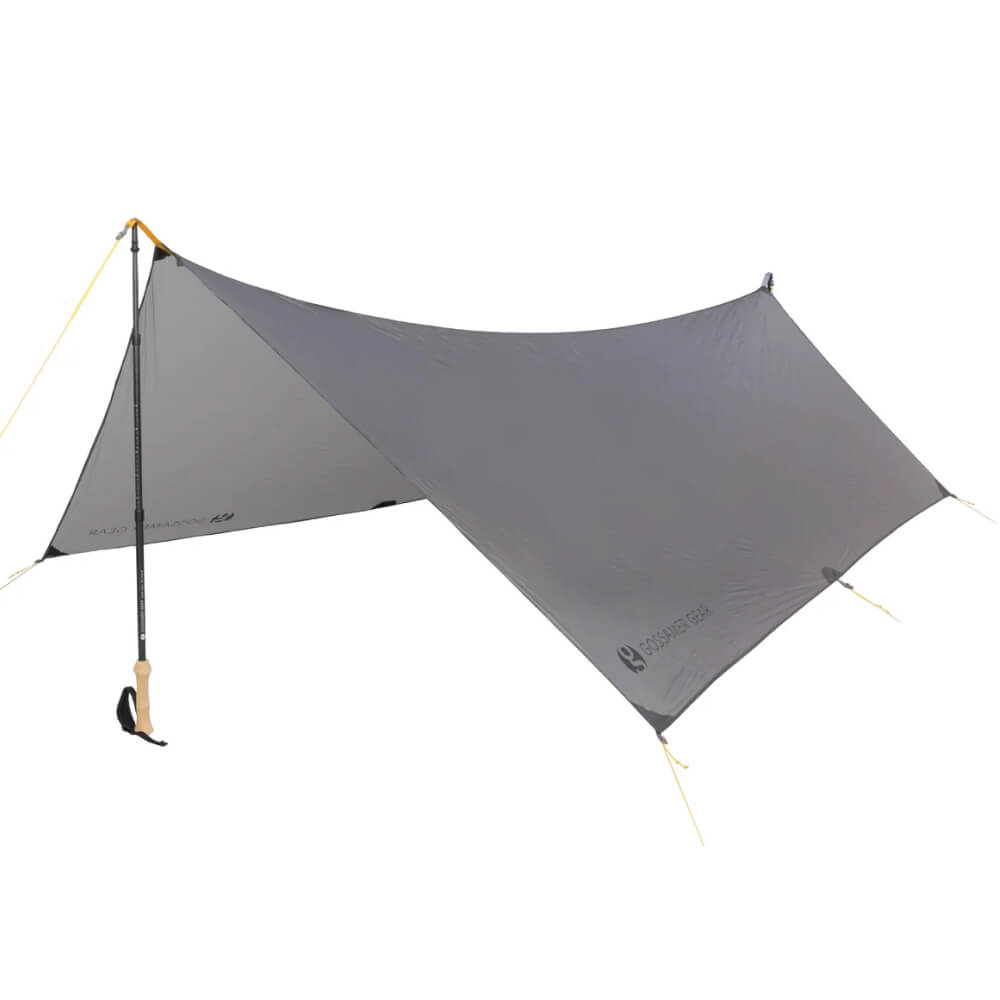
Gossamer Gear Twinn Tarp
If you want to spend the least amount of money on a super ultralight shelter, we recommend the Gossamer Gear Twinn. Seriously, just $130 for a sub-10 ounce catenary cut A-frame tarp in a killer bargain. We really like GG’s custom, high-tenacity 10d sil-nylon, which is highly waterproof and yields a great pitch. This tarp is also available in a solo cut, but for versatility and comfort, we recommend keeping with the 2P model as it only adds a smidge of weight.
- Price: $130
- Weight: 9.7 oz
- Shape: Catenary, Tapered
- Material: 10d SIL/PU Nylon
- Length x Width: 9.5′ x 8.3
- Tie Off Points: 8
- Area: 79.5 ft²
- Area/Weight: 8.2 ft²/oz
- Pros: Super Ultralight. Great value. Easy setup.
- Cons: A-frame pitch only.
Top Picks: Group Shelter Tarp
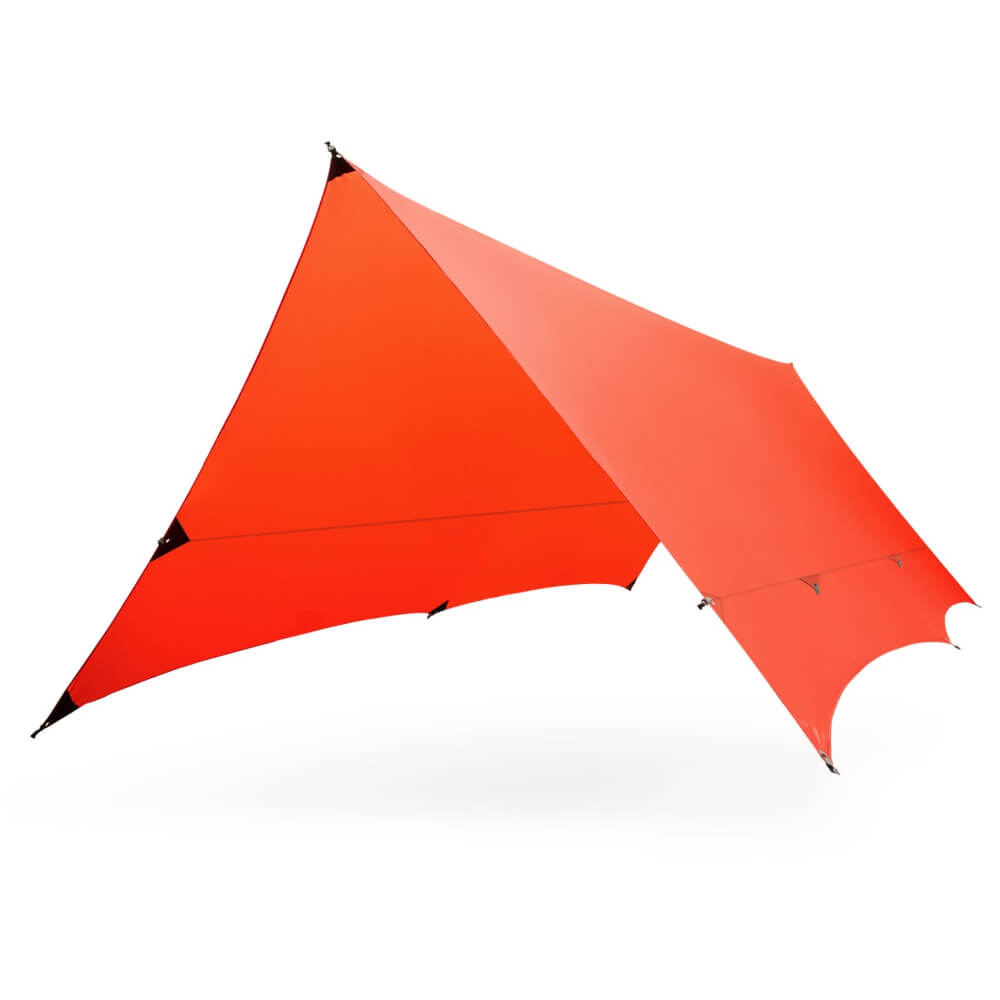
Kammock Kuhli XL Tarp
The sheer size of Kammock Kuhli XL is truly something to behold. At 16.5 x 14.2, this absolutely massive hexagon-shaped tarp is capable of covering 2-3x the area of the typical rectangular flat tarp. If you’re on a group outing with 6-10 people, it’s the perfect cover to place overtop of the communal/kitchen area. Pack one, learn to set it up, and you will be the MVP of the trip. Don’t let rain keep you from socializing in comfort in the backcountry!
- Price: $250
- Weight: 33.4 oz
- Shape: Flat Hexagon
- Material: 15d ripstop nylon
- Length x Width: 16.5′ x 14.2′
- Area: 234.3 ft²
- Area/Weight: 7.0 ft²/oz
- Pros: Ideal large group shelter. Absolutely massive. Fair price. Works well with hammocks.
- Cons: Any tarp this large can be difficult to pitch. Large group-use only makes it kind of niche.
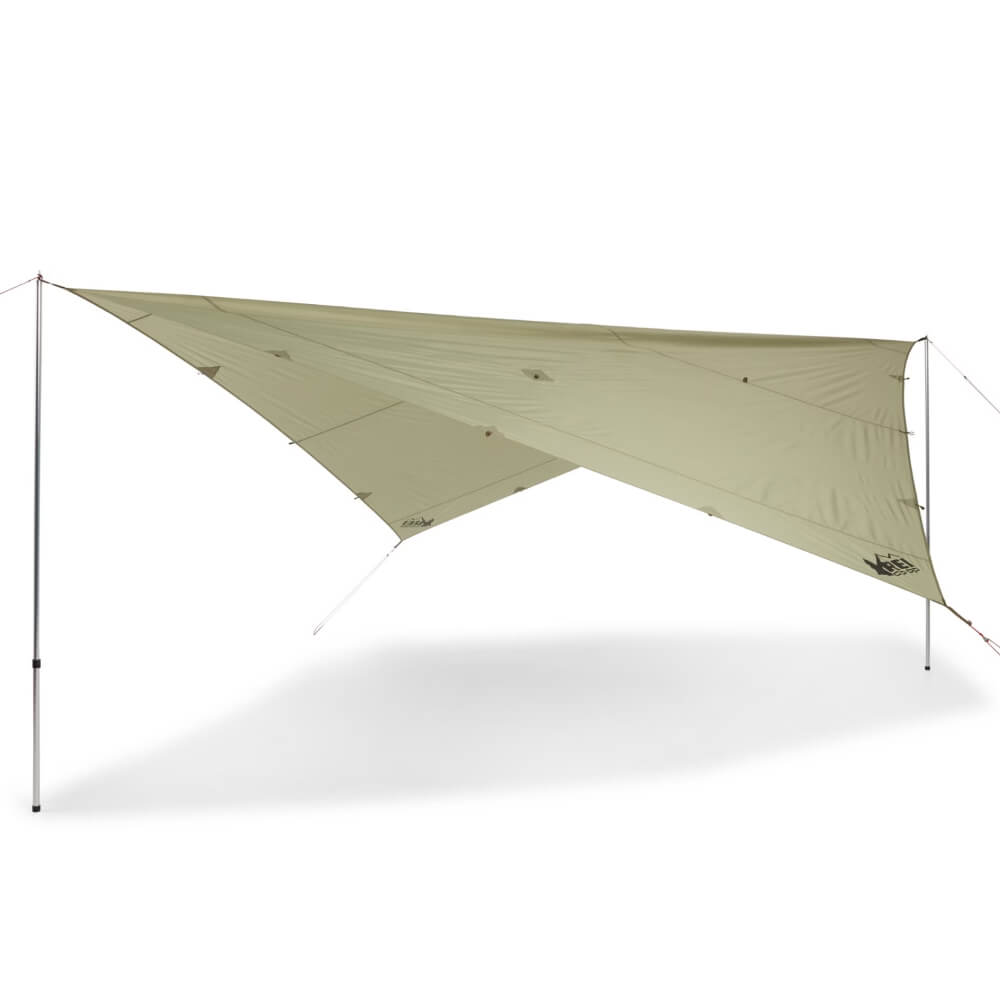
REI Trailbreak Tarp
It’s hard to argue with such an affordable group shelter as the REI Co-op Trailbreak Tarp. At 12′ x 12′, it’s just shy of 2x of the covered area of your typical 10×8, which makes it great for use over the kitchen with medium sized groups in the 5-8 person range. Weighing just over two pounds, it’s definitely not the lightest, nor is the 75d polyester fabric in any way high tech. But it gets the job done for under $100, and we promise your group will be thankful.
- Price: $80
- Weight: 33 oz
- Shape: Flat Square
- Material: 75d polyester
- Length x Width: 12′ x 12′
- Area: 144 ft²
- Area/Weight: 4.4 ft²/oz
Shaped Tarp Shelters
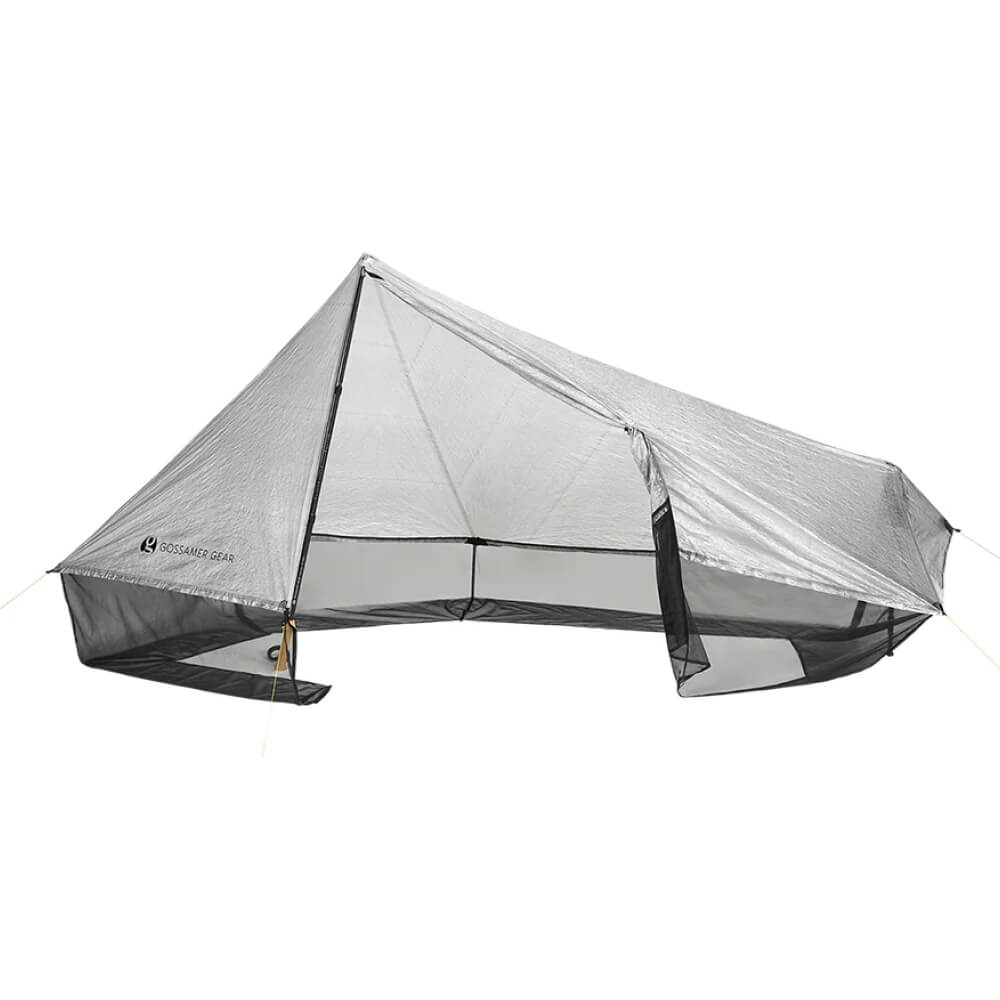
Gossamer Gear The DCF Whisper
For use as a primary shaped tarp shelter, choose Gossamer Gear The DCF Whisper. This floorless, bugproof 1P tarp is preposterously ultralight, coming in at just 9.8 oz. The high price tag reflects its Dyneema construction, which does not sag or stretch as it becomes wet. We love the full bug mesh skirt, which offers complete protection from mosquitos. The offset pole placement creates more room in the primary sleeping area, which is another huge plus.
- Price: $499
- Weight: 9.8 oz
- Shape: Elongated hexagon
- Material: DCF .51
- Length x Width: 8.5′ x (4′-2′ tapering)
- Area: Unlisted
- Area/Weight: N/A
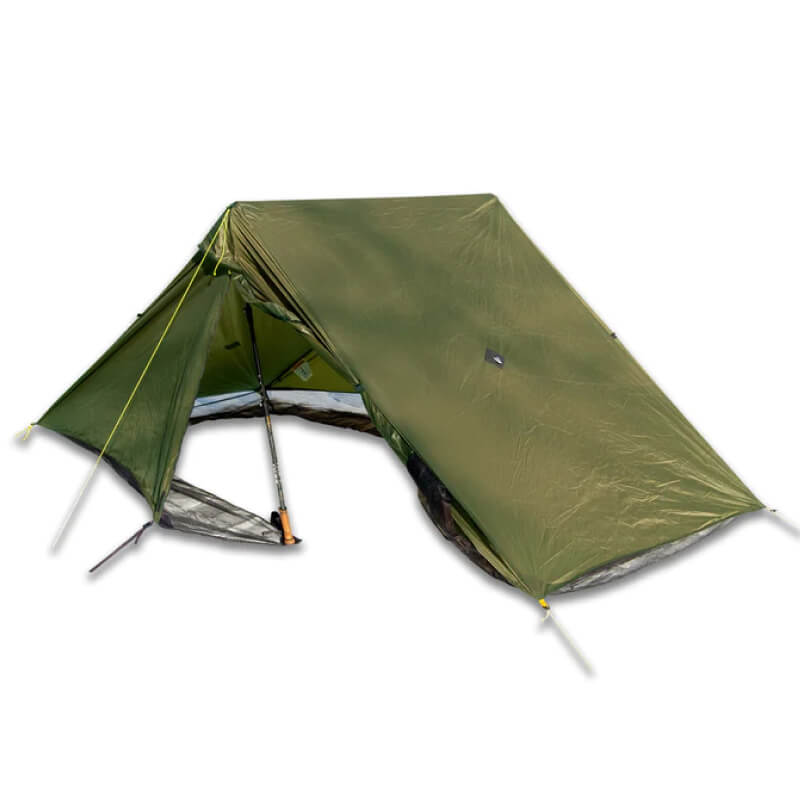
Six Moon Designs Owyhee Backpacking Tarp
The Six Moon Designs Owyhee backpacking tarp is like a larger and more modular version of the Zpacks Duplex archetype. The dual apex fly pitches with a pair of trekking poles, and features a mesh skirt for bug proofing. It is floorless (hence why we’ve categorized it as a tarp), but comes with a modular bath tub floor if you’d prefer to pitch it more like a traditional trekking pole tent. The size of this design is really nice, definitely larger than your average 2P shelter. And it has some nice features, including peak vents, gear clotheslines, and four independent doors that can be rolled up without compromising the pitch.
- Price: $310
- Weight: 24.6 oz
- Shape: Hexagon
- Material: 20D Sil Nylon
- Length x Width: 9.5′ x 7′
- Area: 53 ft²
- Area/Weight: 2.1 ft²/oz
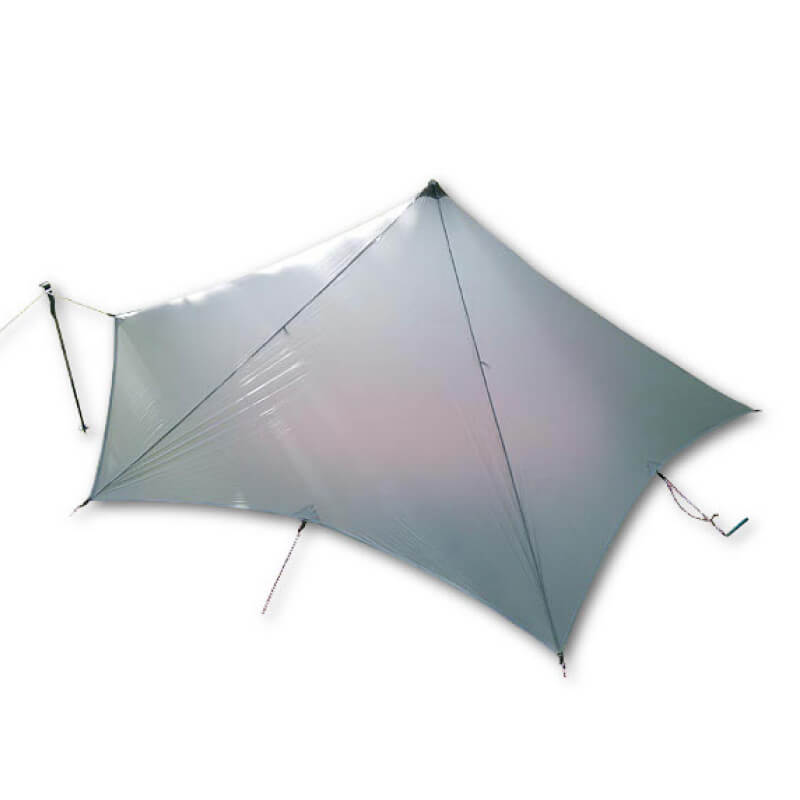
Mountain Laurel Designs Trailstar (DCF)
The MLD Trailstar exists at the intersection of pyramids and traditional backpacking tarps. The symmetrical pentagon shape is simple, bombproof, and highly configurable. Pitch the windward edge low to the ground and loft the leeward with a trekking pole to create a door. There are no zippers, which reduces the likelihood of mechanical failure. Trailstar fills a unique niche and is largely unequaled on the market. What a cool backpacking tarp! Also available in a slightly heavier and less expensive 20d sil-poly fabric.
- Price: $470
- Weight: 12 oz
- Shape: Pentagon
- Material: 75d polyester
- Length x Width: 12′ x 12′
- Area: 65 ft²
- Area/Weight: 5.4 ft²/oz
Why Choose A Backpacking Tarp
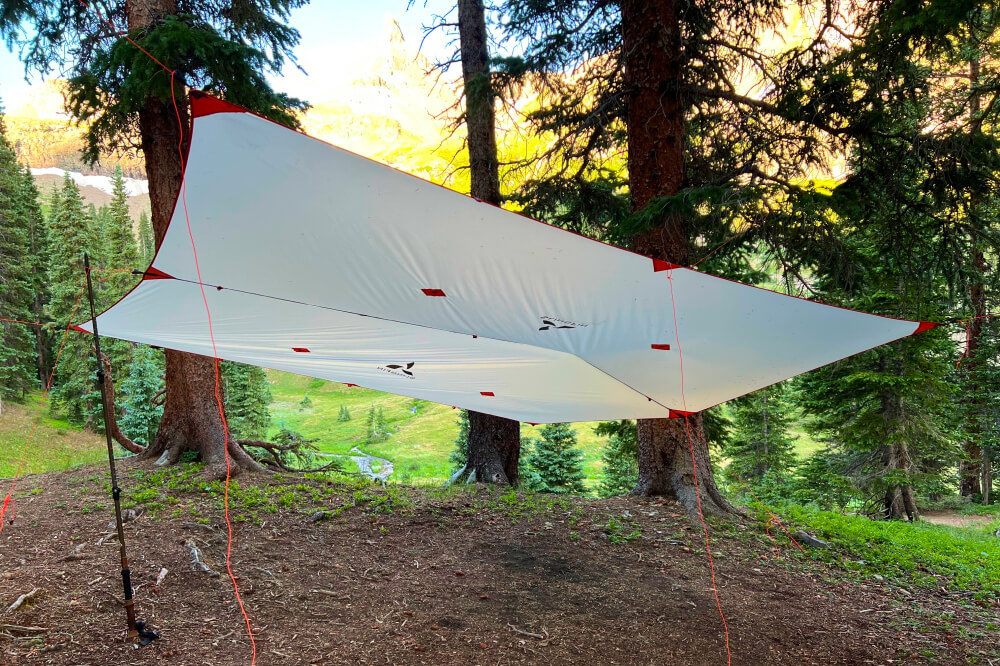
There are plenty of excellent reasons to pack a backpacking tarp, and we have had great success in doing so. Alan and Jaeger – the editorial staff of Adventure Alan & Co – are both huge tarp enthusiasts and both of us highly recommend that you add one to your quiver.
- Can be used as a primary shelter to carry significantly less weight
- More wind-worthy than 3-season tents if pitched properly in low storm mode
- Can be used as an backup/emergency shelter when cowboy camping
- Compatible with super ultralight kits
- Can be used as a communal kitchen shelter on group trips when rain is in the forecast
- Open air shelters provide maximum ventilation in warm weather
- Keeps you in tune with your environmental surroundings, maximizes views
- Highly configurable and customizable pitching
When not to choose a backpacking tarp
As much as we love tarp camping, there are some scenarios better left to fully enclosed tents. Of course, well-tensioned tarps, in conjunction with bivy sacks and ground covers do protect you well enough from all of the following. But tents likeley do it better.
- High bug season
- Reason: You will either be stranded in your bivy sack, or entirely reliant on picaridin + bug head net.
- Very cold and windy weather
- Reason: Tarps are drafty, even if storm-mode pitching is sturdy enough in high wind
- Damp conditions
- Reason: moist air blowing directly in through the open perimeter will dampen your quilt/sleeping bag
- Snowy weather
- Reason: A well-pitched tarp can bear some snow-loading, but the pitch may eventually sag, collapse, or fail
- Reason: You will have little-to-no defense against spindrift
Backpacking Tarp Definitions
For the purposes of this article, we use the following definitions. However, tarps are a niche genre with a wide array of types and sub-types. Many people use these words interchangeable, differently, or synomously, and may not agree on any specific definition relative to another.
Tarp
- A sheet of waterproof fabric that is used to protect against the elements.
Backpacking Tarp:
- A lightweight sheet of waterproof fabric that is used to protect against the elements. Backpacking tarps are most frequently used as either a tent replacement, communal dry patch, or emergency shelter. All of the following types of tarps are technically backpacking tarps. But for the purposes of this article, we use “backpacking tarps” to refer specifically to the family of lightweight flat tarps, and the most basic catenary tarps that most people expect to see when they think of the word, “tarp.”
Flat Tarp:
- A flat tarp is the simplest type of tarp. The sheet of fabric is either configured into a square, rectangle, or hexagon. It can be pitched in the widest array of configurations. An example of a flat tarp is the Hyperlite Mountain Gear Flat Tarp or a classic, inexpensive blue yard/construction tarp.
Catenary Tarp:
- A catenary tarp (or cat tarp) is a tarp with a distinctly curved ridgeline that is designed to be pitched in A-frame mode. Cat tarps are more taut and easier to pitch in A-frame mode than flat tarps, but can be pitched in far fewer other configurations. An example of a catenary tarp is the Mountain Laurel Designs Grace Tarp
Tarp Shelter:
- A space that is protected from the elements by a tarp
- A type of tarp that is designed to be used as a primary shelter, such as a shaped tarp, pyramid tarp, or catenary tarp
By definition 2, a flat tarp is not inherently a tarp shelter. But a flat tarp can be used to create a tarp shelter (by definition 1)
Shaped-Tarp
- A shaped-tarp is any type of backpacking tarp with a structure that is more complex than a flat tarp. Shaped tarps are usually designed to be used primary shelters. An example of a shaped-tarp is the Mountain Laurel Designs Trail Star. While catenary tarps like the Mountain Laurel Designs Grace Tarp are technically shaped-tarps, they look and behave more like flat tarps, which is why we have grouped those two together.
Pyramid Tarp:
- A pyramid tarp, also known as a pyramid tent, or just a “mid”, is a specific type of shaped tarp shelter that pitches into a 4-sided geometric pyramid shape. Pyramids are one of, if not the, most-storm-worthy type of tarps, and are a popular type of primary shelter.
Flat Tarp vs Catenary Cut Tarp
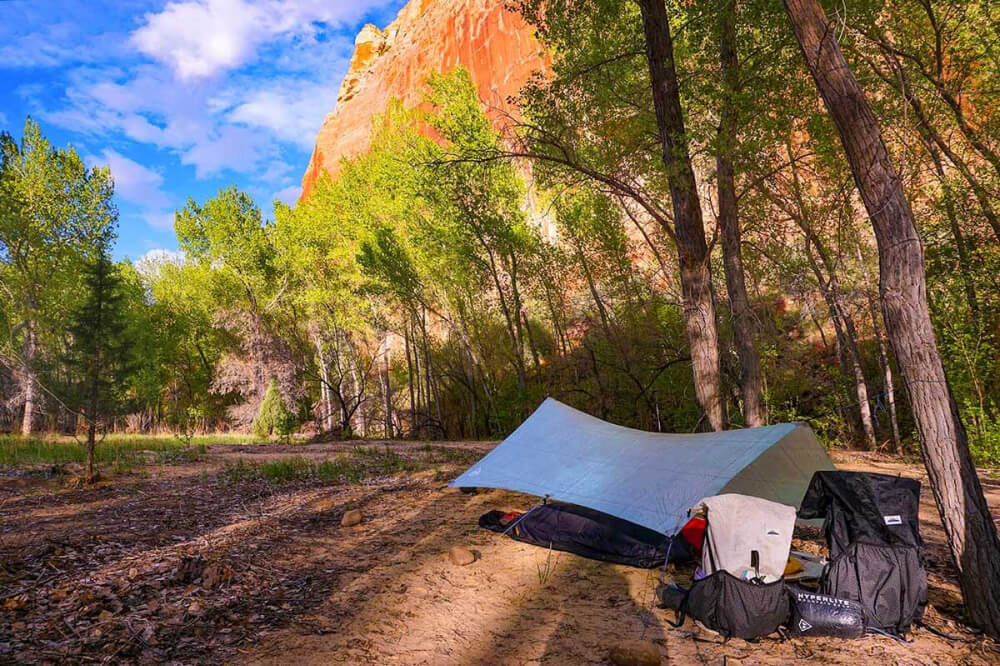
When choosing a backpacking tarp, the first thing you will need to decide on is whether to choose a flat tarp (rectangle, square, hexagon) or a catenary cut tarp (catenary refers to the curved ridgeline). And the answer to the question is largely dependent on intended use. Neither is strictly better.
A catenary cut tarp is designed to be pitched as an A-frame, and is at its best and most taut in A-frame mode. Some cat tarps can be pitched wider and flatter, or in other configurations, but generally speaking, it’s A-frame 90+% of the time for most people. Compared to flat tarps, catenary cut tarps are easier and faster to pitch in A-frame mode, and are also more taut and secure in that configuration. If you are shopping for a tarp to use as a super ultralight primary shelter replacing a tent, or as an emergency shelter to supplement cowboy camping, we recommend a catenary cut tarp.
A flat tarp, on the other hand, is infinitely configurable and can be pitched in a wide array of modes to meet the specific needs of your group, environment, wind, and campsite. One of our favorite use cases for a flat tarp is to create a communal sheltered area for cooking and hanging out in wet weather on group outings. But they can of course still be used as primary shelters, wind walls, tent porches, hammock rain protection, and much much more. Because of their ability to pitch in low-to-the-ground storm mode, flat tarps offer superior protection over catenary tarps in stormy weather.
While catenary cut tarps make for a superior A-frame pitch, flat tarps can also be set up in A-frame. However achieving perfect tension in A-frame with a flat tarp requires more work, and parts of the ridgeline or sidewall will often have just a bit of slack.
If you are only planning on purchasing one backpacking tarp, we recommend choosing a flat tarp over a catenary tarp, because they are more versatile – everything a catenary tarp can do a flat tarp can also do. But if you are open to creating a tarp quiver, then it would be ideal to have one flat tarp, and one catenary tarp.
Choosing the right size
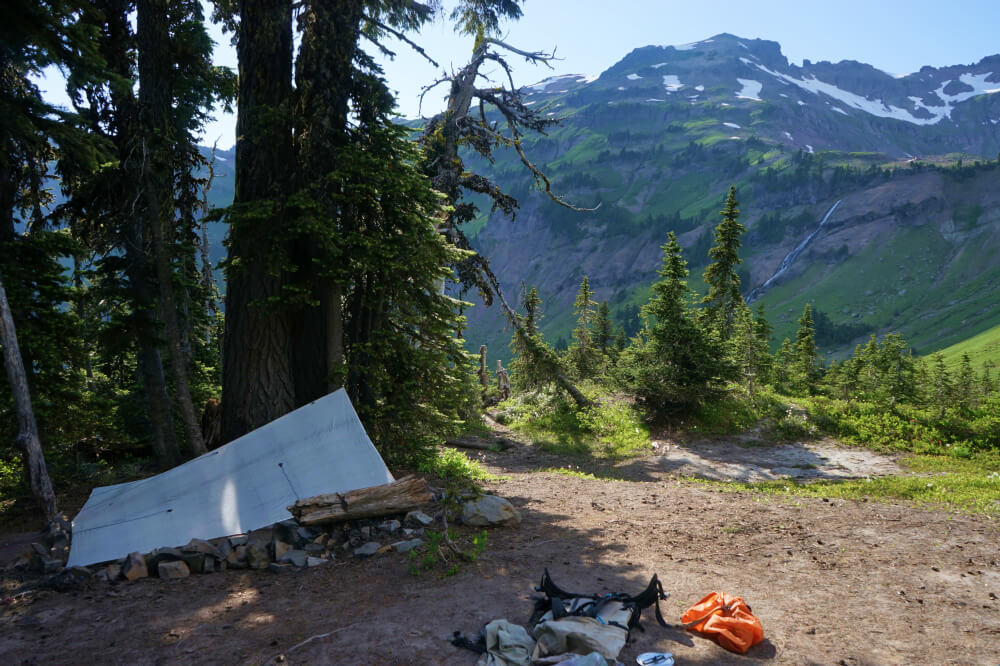
Once you have decided between a flat tarp vs catenary cut tarp, the next decision you will need to make is regarding size. And for a shortcut, when given the option, we generally recommend choosing the larger backpacking tarp. That’s because a bit of extra fabric likely only increases weight by 1-3 oz (depending on the material), but adds significant versatility and weather protection. Acknowledging that most hikers will only ever own one tarp, choosing a larger model is kind of a no brainer, like choosing a 2P tent over a 1P. But let’s dive in.
For a catenary tarp, this means choosing the 2P model over the 1P. Of course, having the option to sleep two increases the versatility and usability. But it also creates a more protective shelter with increased headroom for solo use. The added space increases protection against strong wind blowing rain in through the unprotected perimeter, while decreasing the likelihood of brushing against wet condensation-covered fabric. Sleeping underneath the high ridgeline instead of a side panel adds lots of ceiling volume.
According to Ron Bell at Mountain Laurel Designs “About 75% of Solo Grace Tarp users prefer the larger Grace Duo Size, especially in heavy rain.” And it’s literally only a one ounce difference between the solo version in DCF and the Duo version. So yeah, you should definitely size up.
For flat tarps, we feel that 10′ x 8.5′ is the ideal size. This is large enough to comfortably sleep two, or shelter four backpackers in a communal kitchen area. 10×8 is fine too, but just a tad narrow. Many brands also offer 8.5′ 8.5′ or 9’x7′, but we recommend against this because the weight savings are so minimal and the extra square footage can be a major boost to usability and protection. Rectangles are also slightly preferable to squares, especially for taller backpackers.
Dyneema Tarps vs Sil-Poly & Sil-Nylon Tarps
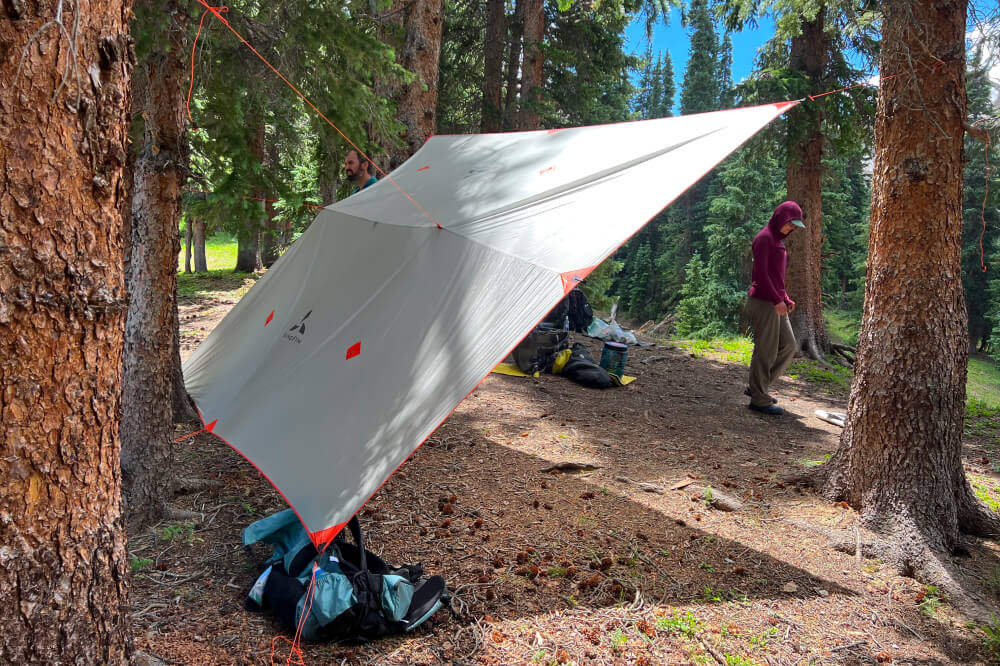
Pros of Dyneema
- Higher tensile strength (can bear more tensioning pressure)
- Absorbs literally no water
- Does not sag when wet or need to be re-tensioned due to wetness
- Lighter weight
- Generally the choice of most veteran tarp users
- almost always factory seam-sealed
Pros of Sil-Poly & Sil-Nylon
- Much less expensive
- Less bulky to pack
- More puncture resistant
- Has a bit of stretch, which makes it easier to get a super taut pitch
- Quieter
Accessorize Your Backpacking Tarp
Backpacking Tarp Ground Cloth
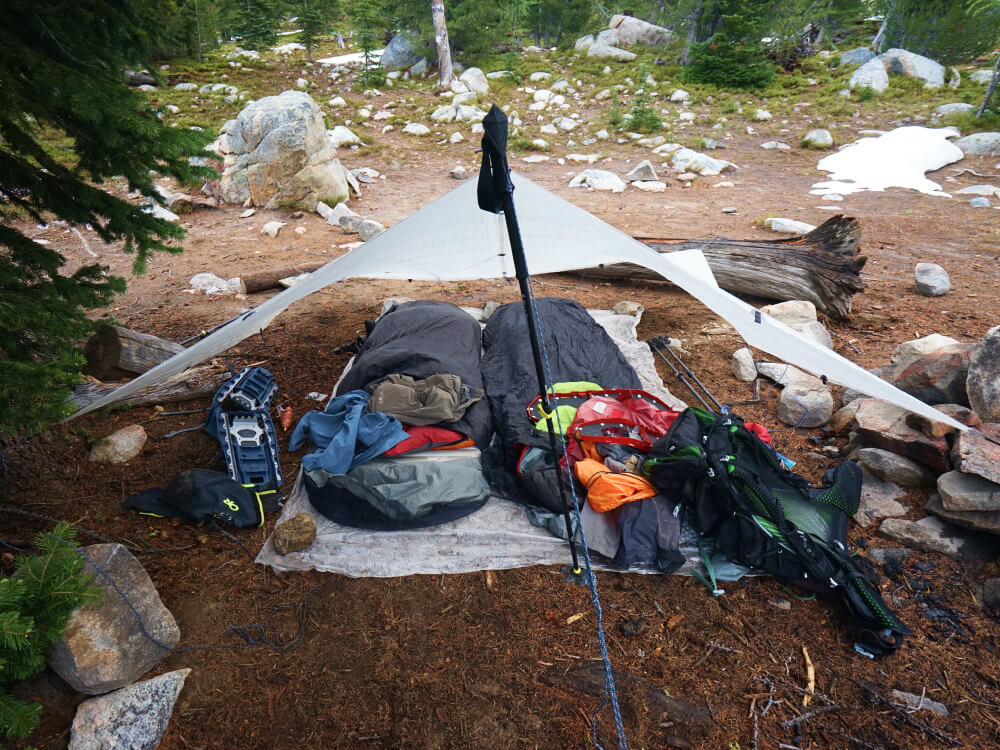
A ground cloth is the most common accessory to pair with a backpacking tarp. Obviously tarps are floorless, and it’s unpleasant to camp directly on wet or muddy ground as the edges of your quilt or clothing accessories may start to get damp as they nudge off of your sleeping pad. The Gossamer Gear Polycryo Ground Cloth is our preferred solution, as it’s very affordable and completely ultralight, weighing just 3.7 ounces with enough width for two campers.
Ultralight Bivy Sack
If you’re expecting cold windy weather or are tarp camping in mosquito season, we recommend carrying an ultralight bivy sack. These typically are made with a waterproof floor, a ripstop windbreaker nylon fabric from torso to foot end, and bug mesh over the shoulders and head area. With this hybrid mapped design, you will solve for all of the common ways in which a tarp fails to protect you on its own (bugs, wet ground, and wind penetration). While tarps are inherently cooler and less insulative than tents, bivy sacks go a long way towards making up for this. The Katabatic Gear Piñon Bivy is an exemplary model, and only weighs seven ounces. Even lighter models exist.
Preferred Backpacking Tarp Stakes
Because a backpacking tarp is entirely dependent on tension in order to achieve a storm-worthy pitch, it’s critical that you use good stakes. We recommend the AnyGear 7075 Y-Stakes, which give an excellent hold, and have multiple tiers of notches in case the stake cannot be pounded all the way in. Dinky shepherd stakes, and other gram-saving hardware is not sufficient for achieving a sturdy tarp pitch.
Supplementing With Found-Material
While this isn’t an accessory per se, you may choose to add a makeshift barrier around the edges of your tarp in cold, windy, and rainy weather. You needn’t pack anything extra, just use rocks and sticks found at the campsite. This helps retain heat, block wind, and prevent rain from blowing in at the sides or ends.
Backpacking Tarp Conclusion
Thank you for reading our guide to the best backpacking tarp where we hope you found an ultralight shelter to meet your trail needs. We cannot stress enough how versatile and effective an ultralight tarp can be when used properly, and highly recommend that every backpacker picks one up at some point, and learns to master it. Happy camping!


Share this entry